Chinese archaeologists uncover 2,300-year-old grain wine, decoding its formula and brewing method
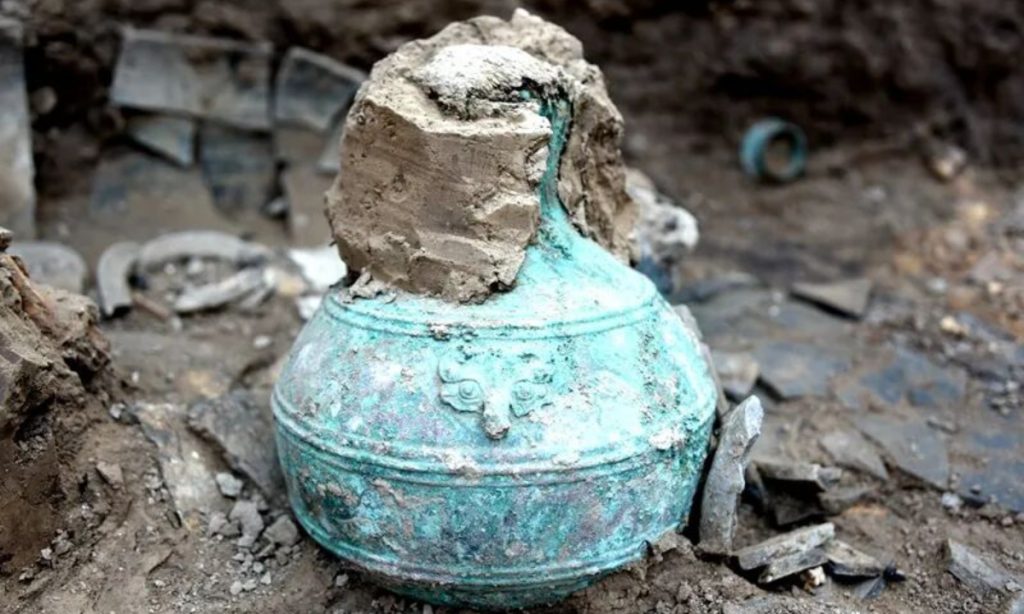
Chinese archaeologists have uncovered 2,300-year-old grain wine residues from a cemetery of people from Qin State during the Warring States Period (475BC-221BC) – roughly the time of Aristotle – in Northwest China’s Ningxia Hui Autonomous Region, revealing the ancient wine’s ingredients and brewing methods through multidisciplinary analysis, Xinhua News Agency reported on Monday.
The Qing State cemetery is located near the Qin Great Wall in Yuanzhou district, Guyuan city in Ningxia, where 183 ancient tombs dating back to the Warring States Period have been excavated.
The archaeologists recovered 3,740 milliliters of ancient liquid remains from a Qin-style bronze garlic-head-shaped pot. The bronze vessel’s double-layer sealing method, textiles inside and muddy outside, preserved the over 2,000-year-old wine with minimal evaporation, making it the most complete and information-rich Warring States Period Qin State-era alcohol relic publicly reported in China.
To accurately decode the recipe and brewing techniques of the ancient wine, the joint archaeological research team from the Ningxia Institute of Cultural Relics and Archaeology and the School of Cultural Heritage at Northwest University conducted multiple analyses and tests on the samples. Using advanced technologies, the team carried out a comprehensive traceability and identification study.
Researchers detected 24 categories of compounds in the liquid remains unearthed from the archaeological site, including organic acids and their derivatives, amino acids and their derivatives, and carbohydrates. The distribution pattern of organic acids was found to be consistent with that of artificially fermented Huangjiu (Chinese yellow wine), confirming that the liquid was a grain-based alcoholic beverage.
The study shows that the Qin people had mastered grain-based fermentation techniques more than 2,000 years ago, using fermentation starters to achieve simultaneous saccharification and fermentation, reflecting the sophistication of their brewing technology during the Warring States Period.
The discovery fills a gap in research on Warring States Period Qin brewing in Ningxia, providing new evidence of China’s ancient grain wine tradition and offering insights into agriculture, food culture, and craftsmanship of pre-Qin period.