South Korea political turmoil drags on as investigators seek extension of arrest warrant for president
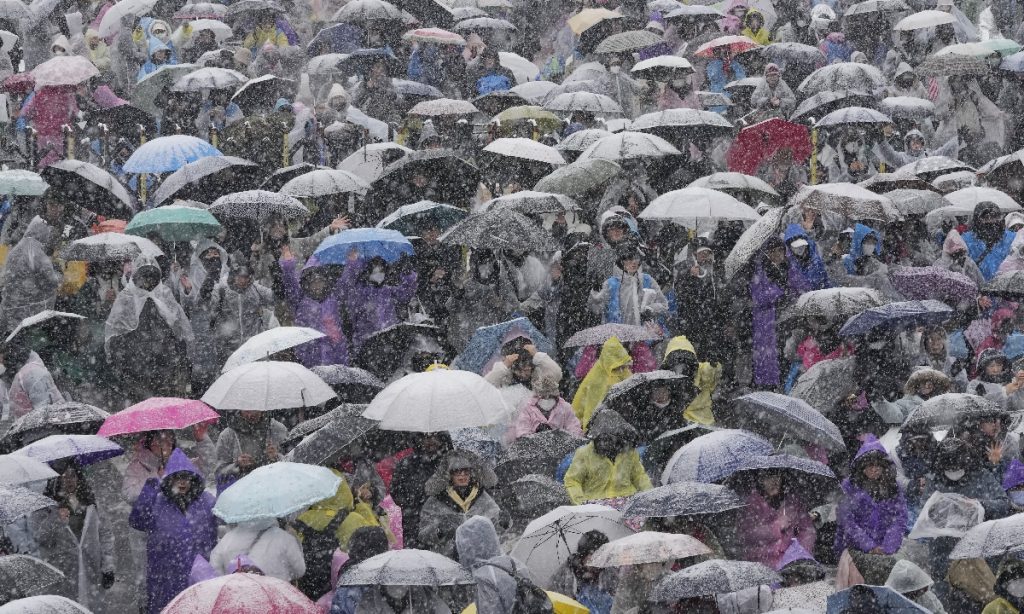
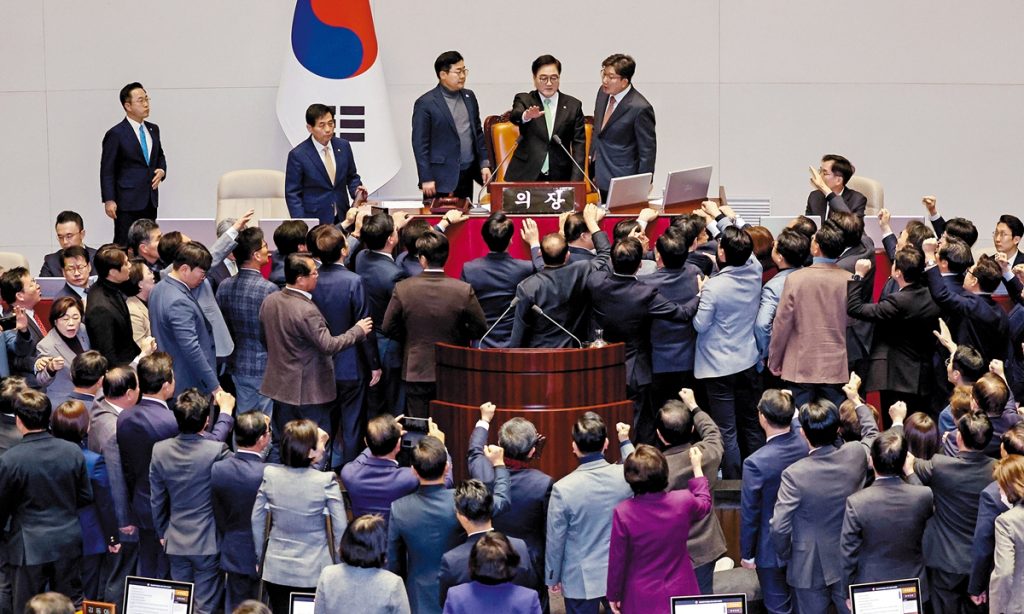
South Korea's political turmoil continued to escalate on Monday, as South Korea's investigating authorities requested an extension of a warrant to arrest the country's impeached president, Yoon Suk-yeol.
Meanwhile, the presence of US Secretary of State Antony Blinken in Seoul further complicates the situation. Representing the outgoing Biden administration, Blinken's visit aims to gain a deeper understanding of South Korea's complex and delicate political landscape, and show support for the pro-US factions within the South Korean government, experts said.
The Corruption Investigation for High-Ranking Officials (CIO), South Korean anti-corruption body, has refiled the warrant at the Seoul Western District Court to extend the deadline for the warrant to detain Yoon, Yonhap News Agency reported Monday.
On Friday the CIO had failed again to serve an arrest warrant on Yoon over his declaration of martial law on December 3, 2024 after presidential security service guards formed a human chain to prevent access to him.
The arrest warrant, the first for a sitting president, was due to expire at midnight on Monday.
Earlier on Monday, Yonhap reported that South Korean state anti-corruption agency has asked the police to take over the execution of a warrant to detain Yoon.
"The CIO sent us an official letter requesting our cooperation without prior consultations," a police official told Yonhap News Agency. "We are internally carrying out a legal review."
Yonhap later on Monday said the state anti-corruption agency's letter asking police to execute a warrant to detain Yoon contains legal issues, police said Monday, effectively rejecting the request.
The Chinese Embassy in South Korea on Saturday advised Chinese nationals residing in South Korea and Chinese tourists visiting the country to enhance their legal awareness and self-protection, according to a statement released on the embassy's WeChat account on Saturday.
The embassy asked them to stay away from local political gatherings and crowded areas, refrain from making public political statements, keep informed about traffic control caused by gatherings, and prioritize personal safety and travel security.
Park Jong-joon, chief of South Korea's presidential security service, on Sunday vowed to keep blocking the attempt to arrest Yoon, the Xinhua News Agency reported.
Around 30 South Korean ruling party lawmakers gathered near the presidential residence to rally against investigators' efforts to detain Yoon on Monday, according to local media.
US weighing on ally
Also on Monday, South Korean Foreign Minister Cho Tae-yul and US Secretary of State Antony Blinken met in Seoul for talks on their countries' bilateral alliance and other issues, officials said, Yonhap News Agency reported.
Blinken on Monday said South Korea-US relations are "bigger than any one leader, any one government." And Cho said South Korea and US reaffirmed no vacuum in their bilateral alliance, said South Korean Foreign Minister Cho, per Yonhap.
Blinken's visit marked the first trip by a top US official since Yoon's impeachment. Blinken arrived in South Korea late Sunday, Yonhap said.
Yoon's surprise martial law imposition sparked concerns it could undermine the alliance with Washington, especially ahead of the launch of the second Donald Trump administration, Yonhap said.
Blinken is on a three-nation tour this week, with planned stops in Japan and France. The trip is widely expected to be his final overseas visit as the top US diplomat under the Biden administration.
Blinken on Monday reaffirmed the US' complete confidence in the strength of South Korea's democracy and the leadership of acting President Choi Sang-mok, according to South Korean finance ministry.
In response, Choi expressed gratitude for Washington's steadfast support and trust in South Korea's democracy and alliance. He further noted that Blinken's visit itself is a testament to the unwavering strength of the South Korea-US alliance.
Blinken's visit to South Korea and Japan during the US political transition period is aimed at consolidating what the Biden administration sees as one of its most commendable political legacies - the strengthening of the US-Japan-South Korea trilateral alliance to counter and contain China, according to Lü Chao, an expert on the East Asian studies at the Liaoning Academy of Social Sciences.
Amid domestic unrest in South Korea, Blinken's visit seeks to encourage political stability within the country. At the same time, as Japan's new leadership shows a relatively more friendly and pragmatic attitude toward China, maintaining such trilateral alliance becomes crucial. Through this visit, Blinken aims to reassure both South Korea and Japan, preventing their complex historical and diplomatic issues from undermining the trilateral alliance, thereby ensuring the stability of the alliance strategy, Lü said.
Also, by being physically present in Seoul at the moment, Blinken's visit, although he carefully avoided mentioning or explicitly endorsing the impeached president, provided support to the extreme pro-US factions within South Korea, Lü told the Global Times on Monday.
In South Korea, which is in the midst of political turmoil following the impeachment of Yoon Suk Yeol, and Japan, Blinken intends to highlight the expansion of US cooperation with both nations as part of the Biden administration's "Indo-Pacific strategy," AP reported on Saturday.
Blinken is not scheduled to meet Yoon. Blinken is expected to steer clear of taking partisan sides in the deeply divided country but instead will focus on policy continuity, the AFP reported Sunday.
The turmoil and lack of a clear leader in Asia's fourth-largest economy comes just as the US is in the midst of its own political transition. While Biden has focused on nurturing US alliances, President-elect Donald Trump, who takes over on January 20, has been dismissive of what he sees as unfair commitments by the US, the AFP said.
Trump said during his latest presidential run that if he were in power he would have strong-armed South Korea into paying $10 billion a year for the presence of US troops, nearly 10 times what it contributes now.
Blinken's visit aims to assess the situation and conduct field research to gain a deeper understanding of South Korea's complex and delicate political landscape, and to accurately gauge the key issues at play, Li Haidong, a professor at China Foreign Affairs University, told the Global Times.
Blinken seeks to demonstrate support for the pro-US factions within the South Korean government. He also seeks to influence forces in South Korea that strive for diplomatic balance, so as to prevent drastic swings in South Korea's current policies, Li noted.
As a representative of the Biden administration, Blinken hoped that South Korea and Japan could closely coordinate to serve the US need for strategic competition with China. However, the reality is that the legacy of strengthening South Korea-Japan cooperation left by the Biden administration may gradually unravel with the return of Trump administration, he said.